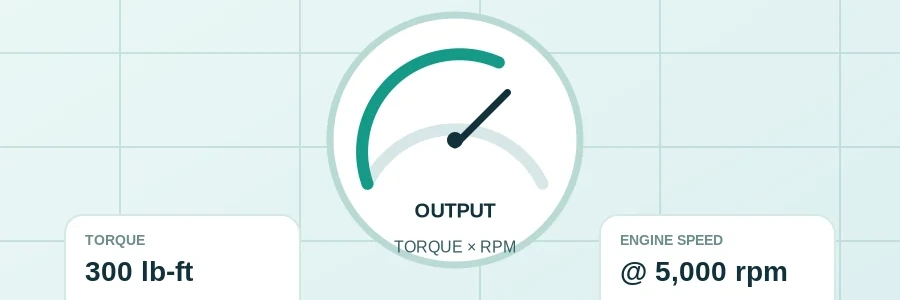
What Does the Torque at RPM to Horsepower Calculator Do?
Power depends on torque and rotational speed at the same operating point. This calculator combines a torque figure with RPM and reports mechanical horsepower and kilowatts. It helps explain why an engine can produce its maximum torque at one speed and maximum power at another. A torque number without the speed at which it is produced is not enough to calculate power.
How to Use This Calculator
- Find torque at the specific engine speed you want to analyse. A torque curve or a matched data point is more useful than a peak torque figure without its corresponding RPM.
- Enter torque and select Nm or lb-ft according to the source. Then enter the RPM at which that torque applies; do not pair peak torque with peak-power RPM unless the curve supports that combination.
- Calculate mechanical horsepower and kilowatts at the entered operating point. Keep the measurement location consistent: wheel torque and engine RPM cannot be combined casually without the intervening gearing.
- Repeat for other matched points if you want to understand the shape of a power curve. The largest calculated point in a small sample is not necessarily the engine's true peak power.
The Maths & Assumptions Behind the Tool
Rotational power in watts equals torque in Nm multiplied by angular speed in radians per second. Angular speed = RPM × 2 × pi ÷ 60. Dividing watts by 1,000 gives kW, so kW = Nm × RPM ÷ approximately 9,549.296586. With torque in lb-ft, mechanical hp = lb-ft × RPM ÷ approximately 5,252.113. The constants arise from units, not from an empirical engine-output assumption.
Worked example
300 Nm at 5,000 RPM gives 300 × 5,000 ÷ 9,549.296586 = 157.08 kW, or 210.65 mechanical hp.
The torque and RPM must refer to the same point on the engine’s power curve. Multiplying peak torque by the RPM of peak power is wrong if peak torque is not produced at that speed. The result is power at the entered RPM, not necessarily the engine’s maximum output.
Why This Matters for UK Drivers
Select the torque unit shown by the source and enter the RPM corresponding to that exact torque reading. If you have a torque curve, read both values from the same point. Combining the highest torque anywhere on the curve with the RPM of peak power can produce a power figure the engine never develops. That is an input mismatch rather than a conversion problem.
The physical relationship is straightforward, but the source measurement still matters. A crank torque figure produces crank power; a wheel torque measurement can include gearing and needs a matching interpretation before comparison with an engine rating. Use the output to check a curve, compare unit conventions or understand a quoted operating point. It does not calculate the full power curve from one reading, and it does not predict acceleration or vehicle speed on its own.
Interpreting the result in practice
At a fixed torque, doubling RPM doubles power because the turning work is delivered twice as often per second. A real engine does not necessarily maintain the same torque as speed rises, so the power curve reflects both quantities. Torque can fall while power continues rising if the increase in rotational speed more than offsets the torque reduction. This helps explain why peak torque and peak power often occur at different points.
The familiar crossing near 5,252 RPM only applies when the numerical axes use mechanical horsepower and pound-feet on compatible scales. A chart using Nm and kW has a different numerical relationship. A graph with differently scaled axes can also appear to cross elsewhere. The crossing is therefore a units observation, not a universal visual test that proves a dynamometer chart correct.
When checking an advertised figure, look for the matching torque and RPM rather than constructing an optimistic combination from separate maxima. The formula is exact for a consistent rotational measurement, but the input data can still be uncertain or incompatible. Preserve the source's conditions and labels alongside any converted result.
As a cross-check, 100 Nm at 3,000 RPM gives approximately 31.42 kW. At 6,000 RPM with the same 100 Nm, it gives approximately 62.83 kW. If the torque at 6,000 RPM has fallen to 50 Nm, power returns to approximately 31.42 kW. The three examples separate the role of torque from the role of speed without relying on a particular engine design.
When using a graph, read the value carefully at the intended RPM and recognise the limits of visual interpolation. A thick plotted line or coarse axis can introduce more uncertainty than the calculator's rounding. Report the result as approximate if the input was read approximately, and keep the chart available for checking.
Why torque and horsepower cross near 5,252 RPM
When both are plotted using lb-ft and mechanical horsepower, the unit definitions make the numerical values equal at approximately 5,252 RPM. It is a unit relationship, not a special engine behaviour.
Peak torque is not enough to calculate peak power
You need the torque at the RPM of interest. Using a peak torque value at a different RPM can create a power figure the engine never actually produces.