What Does the Torque Converter Do?
Torque describes a turning effect and is quoted in several units across manuals and equipment. This converter translates an entered value between newton metres, pound-feet, pound-inches and kilogram-force metres. It is useful when reading a specification in an unfamiliar unit or checking whether two apparently different values agree. It does not select an appropriate torque setting for a fastener or component.
How to Use This Calculator
- Enter the torque figure and select its stated unit. Check especially whether an imperial source says pound-feet or pound-inches; the difference is a factor of twelve.
- Calculate the equivalent Nm, lb-ft, kgf·m and lb-in values. These are different expressions of the same turning moment, not different performance results.
- Retain the context of the original value. Engine torque, wheel torque and a fastener tightening specification can all use Nm but describe different applications.
- If using a converted workshop specification, verify the original vehicle-specific instruction, tool scale and conditions. The converter does not choose a tightening torque, account for lubrication or check whether a fastener is reusable.
The Maths & Assumptions Behind the Tool
The converter uses Nm as an intermediate unit. One pound-foot is approximately 1.3558179483 Nm; one kilogram-force metre is 9.80665 Nm; one pound-inch is approximately 0.1129848290 Nm. Multiply the source by its Nm factor and divide by the destination factor. A kilogram-force is a force unit based on standard gravity, so kgf·m should not be confused with simply multiplying a mass in kilograms by a distance.
Worked example
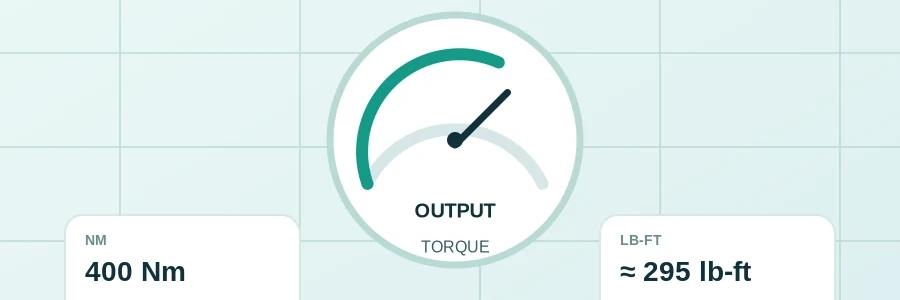
400 Nm ÷ 1.3558179483 = 295.02 lb-ft. The same torque is approximately 40.79 kgf·m or 3,540.30 lb-in.
Pound-feet and pound-inches differ by a factor of 12. Check the unit on a torque wrench and the relevant manufacturer specification. This tool only converts an entered value; it does not supply a safe fastener tightening setting.
Why This Matters for UK Drivers
Read the source unit carefully. Pound-inches and pound-feet differ by a factor of twelve, so confusing them creates a large error. Kilogram-force metres use a force unit; they are not simply kilograms of mass multiplied by distance. The calculator uses the conventional standard-gravity relationship for that unit. The selected unit must match the source before the conversion can be meaningful.
For tightening work, a correct conversion is only one part of following the manufacturer's procedure. Thread condition, lubrication, tightening sequence and any additional angle stage can be relevant. Do not infer those requirements from a converted number. Likewise, engine torque and a fastener torque setting are different applications of the same physical quantity. The tool preserves the entered quantity; it does not make that value safe or suitable for a different job.
Interpreting the result in practice
The same torque can arise from different force and lever-arm combinations. A force acting perpendicular to a longer lever produces more turning moment than the same force on a shorter lever. Unit conversion preserves that turning moment; it does not reconstruct the physical setup or the conditions under which a value was measured. That distinction is useful when technical documents mix SI and imperial notation.
Torque and energy can both be expressed using a force-times-distance dimensional form, but they describe different physical quantities. Torque is normally labelled Nm to preserve its rotational meaning. Likewise, torque is not horsepower: power requires angular speed as well. A vehicle's peak Nm figure by itself cannot tell you its peak kW or acceleration.
Rounding should suit the source. Converting a roughly quoted 400 Nm into many decimal places does not make the original measurement more accurate. For a tool setting, use the manufacturer's tolerance and the tool's appropriate scale rather than assuming a displayed decimal is a required level of precision. The calculator supplies arithmetic, not a workshop procedure.
Pound-inches deserve a separate check because the symbols can be overlooked. A value of 120 lb-in equals 10 lb-ft, not 120 lb-ft. Both convert to approximately 13.56 Nm. Selecting the wrong source unit would introduce a twelvefold error even though the calculator performs its chosen conversion correctly. Read the label on the original document and the receiving tool rather than relying on the number alone.
The kgf·m option can help with older technical documentation. It represents kilogram-force metres and uses standard gravity in its defined relationship to Nm. It should not be confused with a mass moment such as kg·m², which describes rotational inertia. Similar-looking notation can refer to different quantities, so retaining the complete unit symbol is part of using the result responsibly.
For comparison tables, keep one common torque unit across all rows and place the original source unit in a note. This avoids a reader comparing a larger Nm number directly with a smaller pound-foot number and assuming the difference reflects engine performance.
Torque and power are different
Torque is a turning moment. Power depends on torque and rotational speed together. A high torque figure at low RPM does not by itself tell you peak horsepower.
Comparing manufacturer figures
Always check whether the source quotes engine torque, wheel torque or a converted figure. The unit conversion is exact; the underlying measurement may still differ by test standard or source.