What Does the BHP, HP, PS & kW Converter Do?
Vehicle adverts use mechanical horsepower, metric horsepower and kilowatts, sometimes with ambiguous labels. This converter puts a power figure into all three units so specifications can be compared consistently. A small difference between two advertised numbers may be a unit difference rather than a change in the engine. The conversion preserves the physical power represented by the input and applies defined conversion factors.
How to Use This Calculator
- Copy the numeric power figure from the source and identify its stated unit. Look for kW, PS or mechanical hp rather than guessing from the vehicle's market or badge.
- Select that input unit in the calculator. This page treats bhp as mechanical horsepower for unit conversion; if the source uses another definition, clarify it before comparing the output.
- Calculate to obtain equivalent values in the other units. The same physical power is being described by several scales, so a larger PS number does not represent a power gain.
- Retain the original measurement description when using the converted value. Engine output and wheel output stay different measurement locations even after both have been converted into the same unit.
The Maths & Assumptions Behind the Tool
Mechanical horsepower converts to kilowatts by multiplying by approximately 0.745699872. Metric horsepower, or PS, converts to kilowatts by multiplying by 0.73549875. To convert between two non-kW units, first express the value in kW, then divide by the destination factor. The factors are fixed; no vehicle mass, engine capacity, fuel type or drivetrain percentage enters this calculation. Rounding happens for presentation and does not represent measurement accuracy.
Worked example
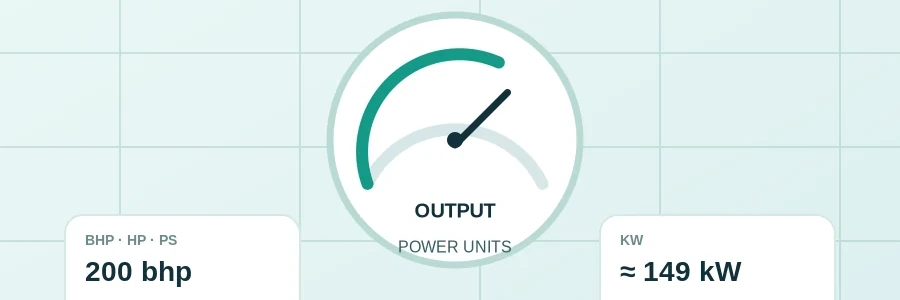
200 mechanical hp × 0.7456998716 = 149.14 kW. Dividing that by 0.73549875 gives 202.77 PS. A figure of 200 PS would instead be 147.10 kW.
Mechanical horsepower and metric horsepower are different units. “Brake” describes how power is measured; confirm whether the quoted manufacturer figure uses mechanical hp or PS before comparing cars. The converter changes units, not crank power into wheel power.
Why This Matters for UK Drivers
The letters PS refer to metric horsepower. Mechanical hp is slightly larger, so an identical engine power produces a slightly higher numerical PS value. The term bhp describes brake horsepower and is normally used here with the mechanical-horsepower conversion. If a manufacturer uses a different convention, follow the actual specification rather than assuming that every label in an advert is precise.
Converting units does not convert measurement location. Crank horsepower stays crank horsepower, and wheel horsepower stays wheel horsepower after conversion to kW. Nor does the converter adjust a manufacturer's rated output for age, maintenance, altitude or tuning. When comparing specifications, preserve the measurement basis alongside the unit. If a dyno report and a brochure disagree after the units are aligned, investigate their conditions before interpreting the difference as missing or gained power.
Interpreting the result in practice
A useful check is to convert in both directions while keeping adequate precision. A 100 kW figure corresponds to roughly 134.10 mechanical hp and 135.96 PS. Converting a heavily rounded 134 hp back to kW will be close to 100, but it will not reproduce every original decimal. That small rounding difference is separate from the much larger error of treating PS as mechanical hp.
Brake horsepower describes a power measurement convention, while horsepower is also used loosely in marketing. The converter cannot determine which definition an ambiguous advert intended. Prefer a technical specification that gives kW or explicitly identifies the horsepower standard. When comparing a UK listing with a European one, check model year, engine variant and measurement location as well as units; conversion alone does not establish that the cars have identical specifications.
Power is a rate of doing work. It differs from stored energy and from torque. A kW figure therefore cannot be substituted for a battery's kWh capacity or for an engine's Nm output. Keeping these distinctions clear is useful when reading EV and combustion specifications side by side, even though this page only changes power units.
For an imported vehicle, preserve both the source value and its converted equivalent in your notes. Writing '150 kW, approximately 201 hp' is clearer than replacing the source permanently with a rounded horsepower figure. If another listing says 204 PS, that may be essentially the same power after rounding rather than a different engine tune. Check the actual specifications before attributing the numerical difference to a model variant.
Similarly, electrical input power and mechanical output power are not interchangeable just because both use kW. A charging supply rating, motor output rating and battery capacity describe different parts of an EV. This calculator changes the unit of a stated power quantity; it does not apply motor efficiency, estimate charging performance or reconcile those measurement boundaries.
Is BHP the same as HP?
In everyday UK vehicle specifications, bhp is normally treated as mechanical horsepower measured at the engine under a stated test standard. For unit conversion, this calculator treats bhp and mechanical hp equivalently.
Why PS is slightly higher
PS is metric horsepower and is based on a different defined unit. The same engine therefore has a numerically slightly higher PS figure than mechanical horsepower.