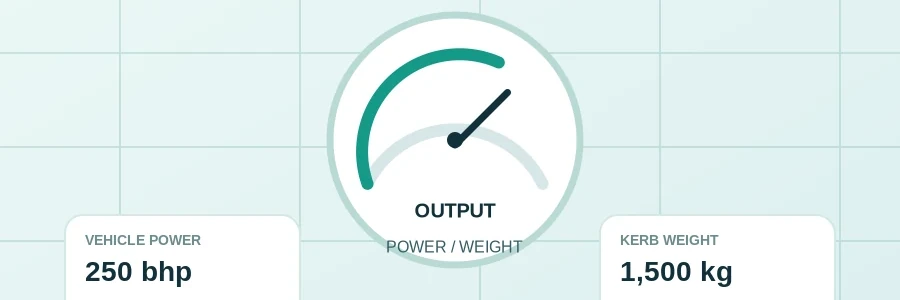
What Does the Power to Weight Calculator Do?
Power-to-weight expresses how much rated power is available for a stated vehicle mass. It is useful when comparing vehicles of different sizes because absolute horsepower alone does not show how much mass that power must move. This tool accepts commonly encountered power and mass units and expresses the result on a consistent basis. It also exposes the converted power and weight, making unit mistakes easier to spot.
How to Use This Calculator
- Enter the vehicle's power and select the unit used by the source. Mechanical horsepower, metric horsepower and kilowatts have different numerical values for the same physical power.
- Enter the mass and select kilograms or pounds. Use a consistent mass definition across vehicles. An unladen figure for one car and a laden figure for another do not make a fair comparison.
- Decide whether driver, fuel and luggage should be included for your scenario. Add them to the entered mass when relevant rather than assuming the calculator adds an occupant automatically.
- Calculate and compare the normalised ratios. If changing power or weight, adjust one input at a time so the result shows which change creates the difference. Treat acceleration as a separate question.
The Maths & Assumptions Behind the Tool
The tool first converts the selected power to mechanical horsepower and kilowatts and the selected mass to kilograms. Tonnes = kilograms ÷ 1,000. Horsepower per tonne = mechanical hp ÷ tonnes, and kW per tonne = kW ÷ tonnes. Mass-per-power ratios invert the relationship. At unchanged power, reducing mass by 10% increases power per tonne by about 11.1%, because the original power is divided by 0.9 times the original mass.
Worked example
A 250 mechanical hp car weighing 1,500 kg has 250 ÷ 1.5 = 166.67 bhp per tonne. Converting the power gives 186.425 kW, so the ratio is 124.283 kW/tonne, numerically the same as 124.283 watts/kg.
If passengers and luggage add 200 kg, the ratio falls to 147.06 bhp/tonne. Use the same weight basis for every car in a comparison.
Why this does not predict 0–60 time
Power-to-weight alone does not determine acceleration. Traction, gearing, power delivery, drag and the launch affect it. Our separate acceleration scenario tool illustrates disclosed equations; it is not a validated forecast for a particular vehicle. Use manufacturer or controlled measured acceleration data for actual performance.
Why This Matters for UK Drivers
Choose a consistent mass definition. An unladen or kerb-weight figure, a measured weight with driver, and a fully loaded touring weight are different quantities. Comparing one car empty with another carrying passengers can distort the ranking. If you are exploring the effect of luggage or passengers, add that mass explicitly and keep the power assumption unchanged. The ratio then shows only the weight effect.
A higher ratio does not guarantee a quicker launch or a particular 0–60 time. Tyre grip, traction control, gearing, power delivery and aerodynamic resistance also matter. Use the result to describe one aspect of performance, then consult measured acceleration data where that is the decision. The ratio also says nothing about braking capability, handling, legal loading limits or the suitability of a vehicle for towing. Those questions require the appropriate manufacturer information and checks.
Interpreting the result in practice
Power-to-weight ratio helps compare the scale of available power against vehicle mass, but it leaves out how that power reaches the road. Gear ratios, the torque curve, traction, aerodynamic resistance and shift behaviour all matter to actual acceleration. Two vehicles with equal ratios can therefore have different standing-start and high-speed performance. A ratio is descriptive; it is not a timed-test forecast.
Mass deserves as much attention as the headline engine figure. A brochure may use a particular kerb-weight definition, while a track measurement may include a driver and equipment. Adding 100 kg has a larger percentage effect on a light car than a heavy one. Run a loaded scenario when comparing real use, and label both the power measurement and mass basis when sharing the result.
A 200 hp car at 1,000 kg has 200 hp per tonne. Adding 100 kg without changing power lowers the ratio to about 181.82 hp per tonne. To restore 200 hp per tonne at 1,100 kg would require 220 hp. This example shows why comparing an unloaded car with a loaded one can hide a meaningful difference even though both advertisements quote the same engine output.
Mass-per-power output reads in the opposite direction: fewer kilograms per horsepower means more power relative to mass. Label the unit when comparing numbers so a lower kg/hp result is not mistaken for a worse result simply because a higher hp/tonne figure would be better. The two are alternative expressions of the same ratio, not independent pieces of performance evidence.
Kerb weight or gross weight?
For comparing published vehicle performance, kerb weight is the usual starting point. For a loaded vehicle, use the actual operating weight if that is the scenario you care about.
Why the ratio is not an acceleration prediction
Traction, gearing, tyre grip, torque curve, aerodynamics and drivetrain behaviour all influence acceleration. Power-to-weight is useful context, but it cannot fully predict a 0–60 time.