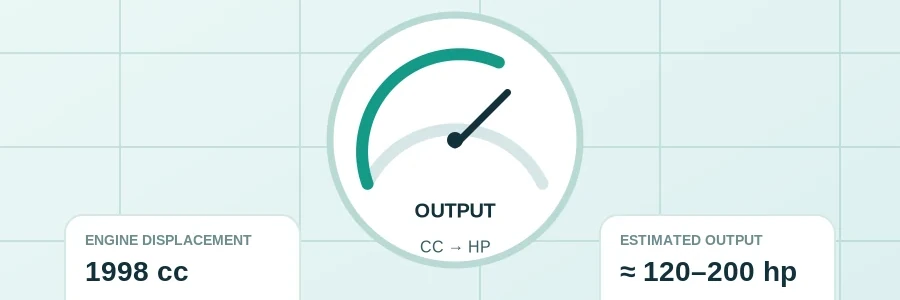
What Does the CC to HP Calculator Do?
Engine displacement and horsepower are not equivalent units. This tool therefore asks for a specific-output assumption, expressed as horsepower per litre, and shows a range rather than pretending every engine size has one power figure. It can also work backwards from a horsepower target to an implied displacement range. The result is a transparent scenario calculation, useful for understanding assumptions and checking rough comparisons, not for identifying an unknown engine's actual output.
How to Use This Calculator
- Select the direction you want to explore: displacement to horsepower, or horsepower to an implied displacement range. The two directions use a chosen specific-output assumption rather than a physical unit equivalence.
- Enter engine capacity in cc for the forward calculation or the target horsepower for the reverse calculation. Use the actual specification where available; a rounded engine badge can hide a slightly different swept volume.
- Choose a scenario or select custom and enter lower and upper horsepower-per-litre values. Keep the minimum no higher than the maximum. A preset is a planning assumption, not proof that a particular engine produces that output.
- Calculate and inspect the range together with the selected assumptions. If a measured or manufacturer-rated power figure exists, use that figure for a power comparison rather than replacing it with this estimate.
The Maths & Assumptions Behind the Tool
Displacement in litres = cc ÷ 1,000. Lower and upper power equal litres multiplied by the chosen lower and upper hp-per-litre values. In reverse, minimum implied cc = target hp ÷ maximum hp per litre × 1,000; maximum implied cc uses the minimum specific output. The order reverses because a higher specific output requires less displacement for the same target. A scenario range is not a confidence interval.
Worked example
A 1,998 cc engine is 1.998 litres. If you choose an illustrative 100–160 hp/litre scenario, estimated power is 1.998 × 100 to 1.998 × 160: 200–320 hp after rounding. For a 300 hp target under the same assumptions, implied displacement is 1,875–3,000 cc.
These are assumptions, not manufacturer claims. Two engines of the same displacement can have very different output. Use the actual engine’s published power whenever available; this tool is useful for exploring a stated specific-output scenario.
Why This Matters for UK Drivers
An engine's power depends on air flow, combustion, engine speed, boost and calibration as well as displacement. A smaller turbocharged engine can produce more power than a larger naturally aspirated engine. Even engines sharing a nominal capacity can differ substantially between variants. If an advert or vehicle specification supplies an actual rated power figure, use that figure rather than replacing it with the range generated here.
When building a custom scenario, choose a lower and upper horsepower-per-litre value and explain why they are relevant. Narrowing the range without evidence merely hides uncertainty. The source links support unit conversions and measurement context; they do not validate the specific-output presets for a particular vehicle. The reverse mode is especially easy to misread: an implied displacement does not establish a viable engine design, safe modification, emissions outcome or reliable power target.
Interpreting the result in practice
The result has two separate sources of uncertainty: how well the displacement is known and whether the assumed specific output is appropriate. Improving the first does not solve the second. Entering 1,998 cc instead of 2,000 cc makes a small arithmetic difference, while changing the output assumption from 60 to 120 hp per litre doubles the estimated power. This is why the assumption should remain visible alongside any copied result.
The calculation also does not distinguish power at the crankshaft from power measured at the wheels unless you define your specific-output input consistently. A wheel-power figure should not be compared with a crank-power scenario without explaining that measurement difference. Use the unit converter for hp, PS and kW; use a separate drivetrain scenario only if its assumptions are relevant. These are different operations, even when an online advert presents them as interchangeable.
Two-way CC and horsepower estimation
Use CC → HP when displacement is known and you want a plausible power range. Use HP → CC to see the displacement range implied by a chosen specific-output scenario. The second direction is not an engine-sizing recommendation; it is simply the same assumption rearranged.
Specific-output reference table
| Engine size | 60 hp/L | 100 hp/L | 150 hp/L | 200 hp/L |
|---|---|---|---|---|
| 1.0 L | 60 hp | 100 hp | 150 hp | 200 hp |
| 1.5 L | 90 hp | 150 hp | 225 hp | 300 hp |
| 2.0 L | 120 hp | 200 hp | 300 hp | 400 hp |
| 3.0 L | 180 hp | 300 hp | 450 hp | 600 hp |
How to use the range
The useful question is not “what horsepower is this CC?” but “what specific output would be plausible for this type of engine?” A wide result is deliberate: it exposes how strongly the answer depends on engine design.