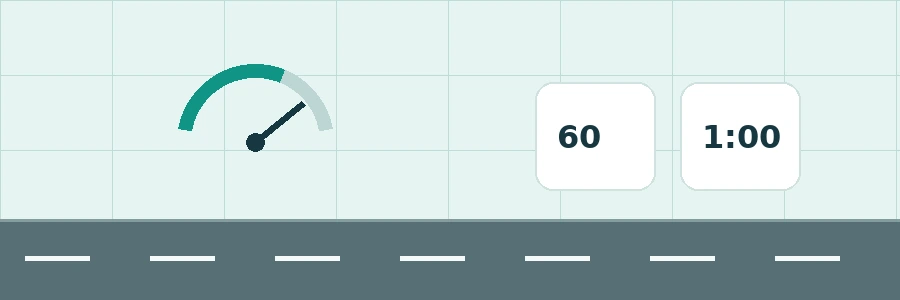
What Does the MPH to Minutes per Mile Calculator Do?
This tool expresses a constant road speed as the time needed to cover one mile or one kilometre. It can make speed differences easier to understand: a change of several miles per hour may save less time on a short trip than the speed numbers suggest. The displayed result is a pace conversion, written as minutes and seconds, rather than a navigation estimate.
How to Use This Calculator
- Enter a positive speed in miles per hour. Decide whether it represents a constant speed or a measured journey average; the same conversion is valid, but its interpretation differs.
- Calculate to display time per mile and time per kilometre. Read the minutes-and-seconds format carefully: 1:30 means one minute and thirty seconds, not 1.30 minutes.
- For a route estimate, use an average that already allows for the conditions you want represented. A speed limit or cruising speed is not automatically the average for a route containing junctions and stops.
- If combining several route sections, calculate their times separately and add them. Do not take the ordinary average of different speeds unless each speed applies for the same duration.
The Maths & Assumptions Behind the Tool
Minutes per mile = 60 ÷ mph. Seconds per mile = 3,600 ÷ mph. Because one mile is 1.609344 kilometres, seconds per kilometre = seconds per mile ÷ 1.609344. Displayed seconds are rounded, so multiplying a rounded pace over a long distance can accumulate a small difference. A speed of zero has no finite pace for completing a mile and is therefore not a valid input for this conversion.
Worked example
At 60 mph, one mile takes 3,600 ÷ 60 = 60 seconds, or 1:00 per mile. A kilometre takes 60 ÷ 1.609344 = 37.28 seconds, displayed as 0:37 per km.
At a constant 30 mph, one mile takes 2:00. Actual journey time includes slower sections, stops and traffic; this is a pace conversion, not a route travel-time prediction.
Why This Matters for UK Drivers
Use average speed over the relevant distance when estimating travel time from pace. Cruising at one speed for part of a route does not mean the whole journey shares that average. Junctions, congestion, lower-speed roads and stops all increase elapsed time. If you already know actual distance and total travel time, that observed average is a stronger input for describing the journey than the highest speed reached.
Time per mile changes inversely with speed. Doubling constant speed halves the time for a mile, but the practical saving on a journey still depends on how much of the route can be travelled at that speed. The calculator does not recommend a speed or account for limits and road conditions. Use it to understand units, compare realistic averages or check a schedule, while allowing separately for breaks and predictable delays.
Interpreting the result in practice
Speed and pace are reciprocal. Moving from 30 to 60 mph halves the constant-speed time per mile from two minutes to one minute. Moving from 60 to 90 mph saves only another twenty seconds per mile. A fixed increase in speed therefore does not remove a fixed number of seconds at every starting speed. This mathematical relationship does not account for stops or establish an appropriate driving speed.
A common averaging mistake arises on equal-distance sections. Driving ten miles at 30 mph takes twenty minutes; ten miles at 60 mph takes ten minutes. The total is twenty miles in thirty minutes, or 40 mph, not the arithmetic average of 45 mph. Add elapsed times and divide total distance by total time for the correct journey average.
The kilometre output is useful when comparing records from different measurement systems. Keep the distance unit with the pace, since one minute per mile and one minute per kilometre represent different speeds. For a real arrival estimate, add stops and expected delays explicitly or use a route service with current conditions. This calculator contains no route, traffic or speed-limit data.
For a longer constant-speed section, use unrounded time where precision matters. At 50 mph, a mile takes 72 seconds, so 25 miles takes 1,800 seconds or thirty minutes. A ten-minute stop would make the overall average for that 25-mile journey 37.5 mph. The vehicle may have cruised at 50 mph, but the elapsed-time average is different.
If your source is already minutes per mile, reverse the relationship by dividing sixty by decimal minutes per mile. Convert seconds into a fraction of a minute first: one minute thirty seconds is 1.5 minutes, giving 40 mph. Treating the display 1:30 as the decimal 1.30 would give an incorrect speed.
Average speed is not cruise speed
A journey's true average speed includes slowing, junctions and stops. Converting a steady 60 mph therefore does not mean a 60-mile real-world trip will take exactly one hour.
Why include kilometre pace?
Vehicle test routes, rally notes and international data sometimes mix miles and kilometres. Showing both makes it easier to move between the two conventions.